
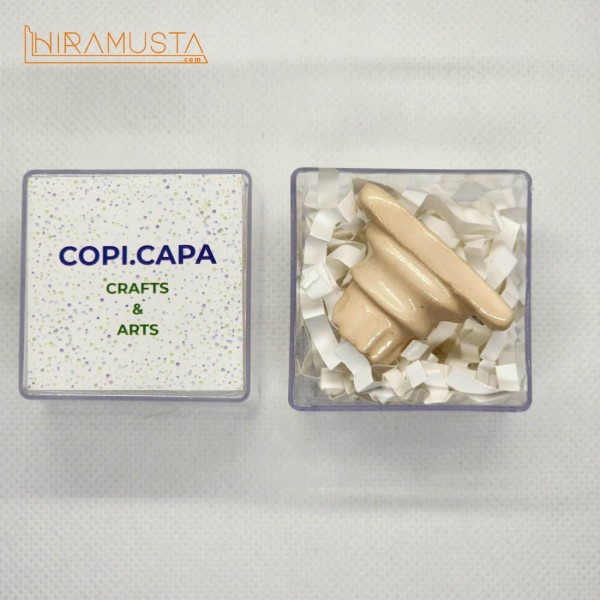
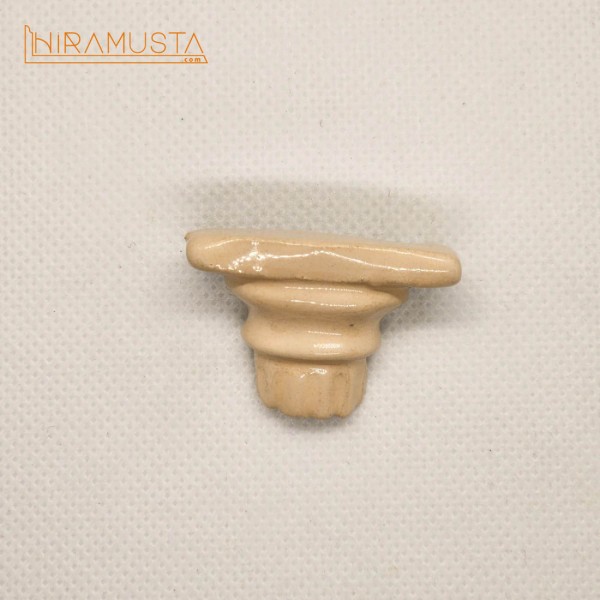
Perhaps the oldest of the Greek-Hellenic column styles in antiquity is the Doric style. Its application dates back to the 12th century BC. Its origin or birthplace is considered to be the southern Aegean and the southern part of the Peloponnese peninsula.
A Doric column is one of the least ornate of the other styles. It could even be described as a crude column. There is no prominent ornamentation on its shaft or capital, although in some applications, the shaft is fluted.
If a symbolic meaning is to be given to this column, it must certainly be strength (power). Indeed, the fundamental structural principles of architecture, namely "solidity," are reflected in this column.
Dimensions: Width 3 cm, Height 4 cm, Depth 1.5 cm
Our products, made from ceramic clay, are handcrafted individually. Therefore, the product you purchase may not be exactly the same as the product shown in the image. The paints and glazes used on fired products do not comply with food regulations. Color variations may occur depending on the firing time and temperature. The metal components are attached using a special adhesive; do not scratch them. Use with care; do not drop, as ceramic products may break.
For orders exceeding stock quantities, please contact our support line for information on the supply process.
What is Ceramic Clay?
It is a soft material whose main components are earth and clay, which hardens when fired at temperatures between 1050-1200 degrees Celsius after the addition of certain chemical powders. After the first firing process, it becomes a ready-to-paint material called ceramic biscuit. After being painted and coated with a liquid called glaze, it undergoes a second firing process to become a waterproof product suitable for daily use.



Easy clip-on handle – Hold the brush and dustpan together for storage; the dustpan edge is serrated to allow easy scraping off the hair without entanglement. High-quality bristles – no burr damage, no scratches, thick and durable, comfortable to remove dust and smaller particles.

